
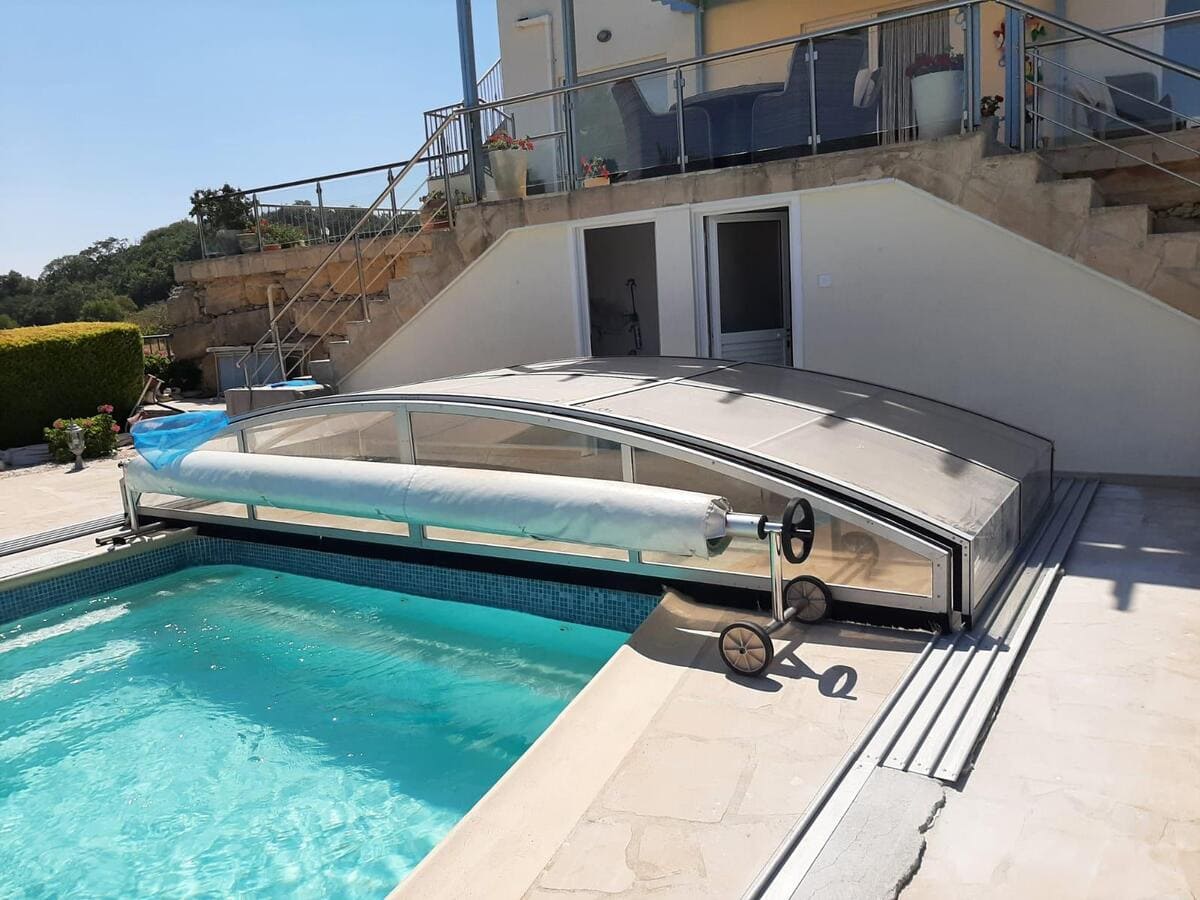
If your pool sits right outside a bedroom window, or you’re looking for a protection solution for a landscaped courtyard, you’ve probably noticed that most pool covers on the market are simply too tall. They act like a glass wall, cutting off the view from your bedroom to the water.
That’s where a low-profile pool cover comes in. It’s not a replacement for a standard pool fence. It’s a protection structure designed specifically for view-sensitive areas — spaces where you want safety and heat retention without sacrificing the view.
Why Standard Pool Covers Don’t Work Near a Bedroom
Standard pool fences or full-height covers are designed to “enclose” the pool. They’re usually over 1.5 meters tall, sometimes reaching 2 meters, with the goal of keeping children or pets out.
But next to a bedroom, that height creates obvious problems:
-
Blocked views: No matter how transparent the glass or polycarbonate is, a tall frame creates a “fence-like” feeling in your line of sight.
-
Spatial pressure: A bedroom is a place to rest. A tall structure right outside the window creates a sense of psychological heaviness.
-
Aesthetic conflict: High-end courtyard design values “borrowed scenery.” An oversized structure breaks the visual continuity.
The Core Advantages of a Low-Profile Pool Cover
The logic behind a low-profile design is completely different. Its goal isn’t to “fence in” the pool — it’s to lay a protective layer flat over the water.
1. It barely changes your view
Low-profile covers are usually kept between 70 cm and 120 cm in height — tall enough to provide a real safety barrier, yet low enough that you still see the full reflection of the water from your bedroom, not a sliced-up landscape.
2. It balances safety and heat retention
Low doesn’t mean unsafe. Modern low-profile covers use an aluminum frame + polycarbonate panel combination that still offers impact resistance. More importantly, it keeps the “greenhouse effect”: absorbing solar heat during the day and reducing heat loss at night, which helps maintain water temperature.
3. It works where full-scale construction permits are difficult
In many regions, structures under 1.8 meters don’t require complex building approvals. If you’d rather avoid a lengthy permitting process, a low-profile design is the more practical choice.
Material Choice: Aluminum Frame + PC Panel Is the Reasonable Option
If you’ve been looking for a cover that won’t crack, won’t rust, and won’t need frequent replacement, this combination is worth a closer look:
-
Aluminum frame: Lightweight, corrosion-resistant, and low-maintenance. For a low-profile structure, aluminum offers plenty of strength without excessive weight affecting operation.
-
Polycarbonate panels: More impact-resistant than glass and lighter in weight. For a cover that needs to open and close regularly, PC panels make single-person operation possible. PC panels also insulate better than standard glass, which helps with heat retention.
By comparison, while glass offers higher clarity, its weight and brittleness are liabilities in a low-profile setting. A poolside area isn’t a high-traffic space where people walk on top every day, so the value of PC panels stands out more.
Manual Operation: Simple, Reliable, and Easy to Live With
Low-profile pool covers are designed to be lightweight enough for manual sliding operation. There’s no motor, no wiring, and no control panel to worry about — just a smooth track system that one person can open and close without effort.
This simplicity is actually an advantage:
-
Nothing to break down: No motor, no electronics, no power supply issues.
-
Lower cost: You’re not paying for automation you may not need.
-
Easy to maintain: A quick wipe of the track and panels is all it takes.
-
Works anywhere: No need for a nearby power source, which makes installation simpler.
For a pool that’s used seasonally, or a courtyard where you open the cover a few times a week, a manual system is often the smarter, more practical choice.
A Cover That Fits Your Situation Should Meet These Three Conditions
If you’re choosing a cover for a pool next to a bedroom or in a view-sensitive courtyard, use these three standards to quickly judge:
| Dimension | What a low-profile pool cover should meet |
|---|---|
| Height | 70–120 cm, tall enough for safety, low enough to keep your view |
| Material | Aluminum frame + PC panel preferred, balancing weight, safety, and insulation |
| Operation | Manual sliding is simple, reliable, and cost-effective |
If you’re looking for a cover solution that won’t block your view while still protecting your pool, you can browse the specifications on our product page, or reach out to us for advice tailored to your pool’s dimensions.


